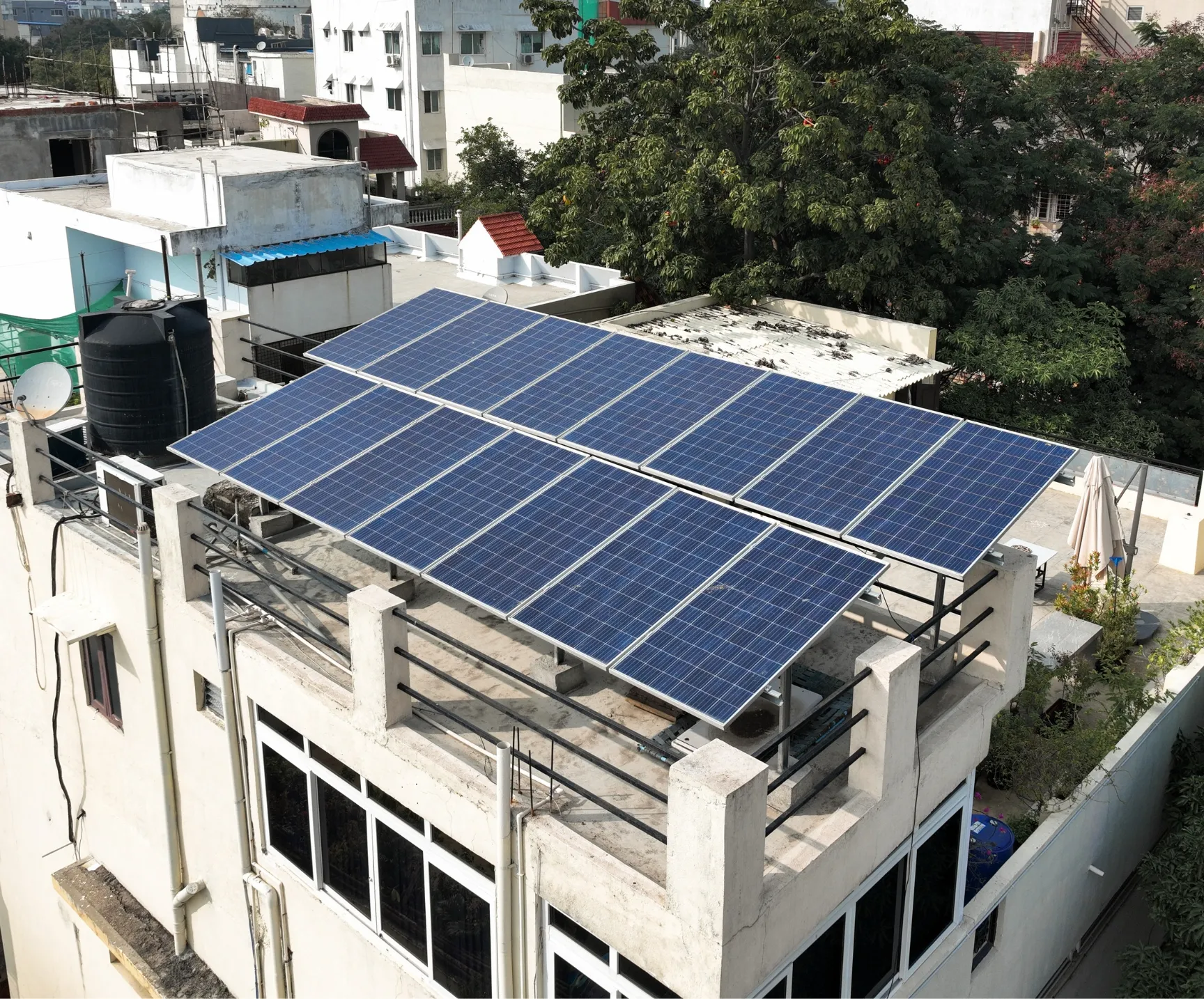
Introduction: Maxira Solar Snapshot and Key Area Fact
The area required for 3kW solar panel installation is typically 250 to 300 sq.ft of shadow-free rooftop space. This area must receive at least 5 hours of unobstructed sunlight daily, free from shadows cast by trees, water tanks, or nearby buildings—meaning it receives at least 5 hours of unobstructed sunlight daily, free from shadows cast by trees, water tanks, or nearby buildings. For proper installation and ongoing performance, you should also allow extra space around the panels for maintenance access, cleaning, and routine inspections.
This guide is intended for homeowners and property managers considering rooftop solar installation. It covers area requirements, panel count, energy output, cost, and installation steps for a 3kW solar system.
A 3kW system can generate approximately 330 to 390 units (kWh) of electricity per month, depending on your location and seasonal sunlight. Maxira Solar is an MNRE-empanelled installer, providing full assistance with government subsidy paperwork and compliance with Ministry of New and Renewable Energy (MNRE) standards. Under the MNRE scheme, homeowners can receive government subsidies of up to ₹54,000 for a 3kW solar system, directly reducing the upfront cost.With rising electricity costs, investing in a 3kW solar system offers a strong return on investment—especially when combined with government subsidies and net metering benefits that lower your monthly electricity costs.
What Is a 3 kW Solar System?
A kilowatt (kW) is a measure of power that indicates the rate at which energy is produced or consumed. When we refer to a 3kW solar panel system, it means the system can produce up to 3 kilowatts of electricity at peak sunlight. The exact number of solar panels required for a 3kW system depends on factors such as the wattage of each panel, available roof space, and shading conditions—the exact number depends on your specific installation circumstances.
In most Indian cities, a 3kW solar system typically generates about 12–15 units (kWh) of electricity per day under standard conditions. This translates to a monthly generation of approximately 360–450 units, which can cover the needs of a small to medium-sized household. For example, in Delhi, a 3kW system connected to BSES Delhi’s grid can offset a significant portion of a typical home’s monthly electricity bill.
Understanding Energy Output and Requirements
How to Analyze Your Electricity Usage
A 3kW solar system generates 12-15 units daily, covering 80% of typical Indian household consumption. Start by analyzing your electricity bills to identify your average monthly kWh (kilowatt-hours) usage. Most households consuming 300-450 units monthly will achieve complete energy independence with a properly sized 3kW installation.
Panel Efficiency and Orientation
Every 1kW of solar capacity demands exactly 100 sq.ft of unshaded rooftop area for optimal performance. A 3kW system requires 300 sq.ft of direct sunlight exposure without obstructions from water tanks, HVAC units, or building shadows. Maxira Solar's site assessment identifies these critical factors during our free roof evaluation.
Monocrystalline panels deliver 19-22% efficiency, generating 15-20% more power than standard polycrystalline alternatives in identical conditions. Panel orientation and tilt angle directly impact your ROI (Return on Investment) — south-facing panels at 15-30° tilt maximize energy yield across Indian latitudes. High-efficiency installations recover their investment costs within 4-5 years through electricity bill savings.
Calculating Panel Requirement
Calculate your exact panel requirement by dividing total system watts by individual panel wattage. A 330-watt panel covers 20.86 sq.ft and produces approximately 1.3-1.5 units daily in peak sunlight conditions. Multiply panel count by surface area to determine your total rooftop requirement for precise system sizing.
The PM Surya Ghar Muft Bijli Yojana provides up to ₹78,000 subsidy for residential solar installations, reducing upfront costs by 40-60%. Net metering policies across states like Maharashtra, Karnataka, and Delhi allow surplus energy export to the grid at ₹2.5-4.5 per unit. These combined benefits accelerate payback periods and maximize long-term savings.
Maxira Solar's MNRE-certified engineers conduct comprehensive energy audits to optimize your system design for maximum efficiency. Our detailed assessment covers roof structural analysis, local sunlight patterns, and utility interconnection requirements. Professional installation ensures 25-year performance warranties and compliance with all safety standards for sustained energy independence.
Area Required for 3kW Solar Panel: Roof Space Explained
For a standard 3kW solar installation in India, you typically need between 6 to 12 panels, depending on the wattage of each panel. The exact number of solar panels required for a 3kW system can vary because the panel count depends on the power output of each unit—most panels range from 250W to 550W. Higher-wattage solar panels allow you to reach 3kW with fewer units, saving valuable roof space.
The number of panels required for a 3kW system depends on the wattage of each panel, typically ranging from 7 to 10 panels for modern systems.
Keep in mind, the total area required and the number of panels also depend on your roof’s orientation and any shading throughout the day. South-facing roofs with minimal shading are ideal, as they maximize energy generation and may reduce the total number of panels required.
Calculate Number Of Solar Panels
To calculate the number of panels needed for a 3 kW solar system, use the formula:
Number of panels = 3000 W ÷ Panel Wattage
For example, if you choose 330W panels:
3000 ÷ 330 = 9.09, so you will need 9 or 10 panels.
If you select 400W panels: 3000 ÷ 400 = 7.5, so you will need 8 panels.
Keep in mind, the exact number of panels required can vary depending on the panel brand and panel efficiency. Higher efficiency panels from reputable brands may generate more energy per square metre, potentially reducing the total area required and improving overall system performance. Panel brand can also impact system pricing and eligibility for government subsidies.
Panel Count Examples By Wattage
Here’s a quick reference for the number of panels needed for a 3kW system based on common panel wattages:
Panel Wattage
Number of Panels Needed for 3kW
250W
12
330W
9
400W
8
450W
7
550W
6
How Much Roof Space Is Needed For 3kW Solar?
Solar panels typically need about 10 sq. ft. of rooftop space per panel for installation. For a standard 3kW solar system using 450W panels, you will need approximately 250–300 sq. ft. of shadow-free rooftop space, with 260 sq. ft. being a common estimate for standard panel sizes. The rooftop space must be a shadow-free area that receives at least 5 hours of unobstructed sunlight per day—shadows from water tanks, chimneys, or neighboring buildings can reduce efficiency and require increased distance between panels.
The area required for a 3kW solar system depends on the wattage and efficiency of the panels. Most modern panels require 250–300 sq. ft. of shadow-free roof space. Higher-wattage panels (such as 450W or 550W+) can reduce the required area to as little as 167–220 sq. ft., making them ideal for homes with limited rooftop space.
Flat RCC roofs often require more space than sloped or sheet roofs because mounting structures are needed to tilt the panels at the optimal angle. Installers also need to leave walking paths, typically 30–40 cm wide, between rows of panels for cleaning and maintenance access. When planning your solar installation, always evaluate the available rooftop space, roof type (RCC flat, tiled, or sheet), and ensure there is sufficient shadow-free area for the system size you need.
Roof Space Requirement Table by Panel Wattage
Panel Wattage
Number of Panels
Approximate Area Required (sq. ft.)
250W
12
300
330W
9
270
400W
8
240
450W
7
220
550W
6
167
Energy Output: How Many Units Will a 3kW System Produce?
A 3kW solar panel system in India typically generates around 12–15 units (kWh) of electricity per day under standard sunlight conditions. This translates to approximately 360–450 units per month, or 4,380–5,475 units annually. For households with moderate energy consumption, this level of generation can significantly reduce electricity bills, making solar a cost-effective solution for managing rising energy bills.Actual energy output depends on panel quality and overall system performance. High-quality panels and professional installation ensure optimal power generation, while factors like shading, roof orientation, and local climate also play a role. For example, a 3kW system in Maharashtra may produce slightly more than in Tamil Nadu due to regional sunlight variation, but both regions can expect substantial savings on monthly energy bills with a well-installed system.
Seasonal And Performance Variations
Summer Generation: Expect higher output, typically 15–17 units per day, due to longer sunlight hours and clearer skies.
Winter Generation: Output may drop to 10–12 units per day because of shorter days and possible fog or haze.
Temperature Derating: High temperatures can reduce panel efficiency by 5–10%.
Soiling Derating: Dust and dirt can reduce output by 2–5% if panels are not cleaned regularly.
Monthly Electricity Bill Impact And ROI For 3kW Solar
Monthly Savings
A 3 kW solar panel system can help homeowners save ₹2,000 to ₹3,000 per month on electricity bills, depending on their monthly consumption and local electricity costs. By analyzing your monthly consumption from past electricity bills, you can estimate the system size needed and the potential reduction in electricity costs. With net metering, any excess power generated is exported to the grid, further reducing your monthly expenses.
System Cost and Subsidies
The total cost of a 3 kW solar system in India typically ranges from ₹1.5 lakh to ₹2.4 lakh before subsidies. With government subsidies such as the PM Surya Ghar Muft Bijli Yojana, the cost can drop to ₹1 lakh to ₹1.4 lakh, making solar more affordable for households. Rising electricity costs across India make solar a cost-effective investment, especially in high-tariff states.
Payback Period Example
The payback period for a 3 kW solar system is usually between 3 to 5 years, depending on your electricity tariff and the total cost after subsidies. After the payback period, the system continues to generate free electricity for up to 25 years, maximizing your return on investment.
For example, at a tariff of ₹8 per unit and a monthly consumption of 375 units, your monthly savings could be ₹3,000. At ₹10 per unit, savings rise to ₹3,750 per month. If you opt for EMI financing, plans can start at ₹2,500 per month, allowing you to offset most or all of your EMI with your monthly electricity savings.
Install Solar Panels: Site Survey, Net Metering And DISCOM Steps
Professional Site Survey and Shadow Analysis
A professional site survey is the first step in the solar installation process. Maxira Solar’s engineers will visit your property to assess the available rooftop area, check for shadows from nearby structures, and determine the optimal panel layout and orientation. This ensures maximum energy generation and system efficiency.
Net Metering Application Process
After the site survey, you’ll need to apply for net metering with your local DISCOM (e.g., BSES Delhi, BESCOM Bangalore, MSEDCL Maharashtra). The process involves submitting your application, providing necessary documents, and coordinating with the utility for meter installation and grid connectivity.
Government Subsidy Steps
Maxira Solar assists you in preparing and submitting all required documents for MNRE subsidies and the PM Surya Ghar Muft Bijli Yojana. Our team ensures compliance with all government guidelines, helping you receive your subsidy benefits quickly and efficiently.
Contact Maxira Solar
Ready to get started? Contact Maxira Solar for a free site survey, expert advice, and complete assistance with subsidy applications and installation.
3kW Solar Cost Breakdown
When calculating the total cost for a 3kW solar panel system, several factors influence the final price. The main cost categories include solar panels, inverter, mounting structures, wiring, and labour. The panel brand, inverter quality, and type of mounting structures all impact the overall system cost and long-term performance. Choosing high-quality components and a reputable installer with proven industry experience ensures reliability and maximizes your return on investment.
For a 3kW on-grid solar system in India, typical costs range from ₹1.5–2.4 lakh before subsidies. Hybrid and off-grid systems may cost more due to additional battery storage and advanced inverters. Government subsidies, such as those under the PM Surya Ghar Muft Bijli Yojana, can significantly reduce your net cost—often by up to ₹78,000—making solar more affordable for homeowners and businesses.
To estimate your net customer cost, first total the component and installation costs (panels, inverter, mounting structures, wiring, and labour), then subtract the applicable government subsidy. This approach gives you a clear picture of your actual investment in a 3kW solar panel system in India.
Off Grid Versus On Grid Versus Hybrid For 3kW
Off-grid solar systems operate independently from the utility grid and require careful battery sizing to ensure enough stored energy for night-time use and cloudy days. The cost of an off-grid setup is higher due to the need for a large battery bank and charge controller, especially if you plan to run high-demand appliances like air conditioners.
On-grid (grid-tied) solar systems are directly connected to the local DISCOM, such as BSES Delhi or BESCOM Bangalore. These systems benefit from net metering, allowing you to export surplus electricity to the grid and offset your monthly bill. On-grid setups use simpler inverter sizing since the grid acts as a backup source.
Hybrid solar systems combine the advantages of both on-grid and off-grid configurations. They include battery backup to ensure a continuous power supply during power outages, providing electricity for essential loads even when the grid fails. Hybrid systems also manage export to the grid and optimize self-consumption, making them ideal for areas with frequent grid interruptions.
Technical Specs And Number Of Solar Components
For a 3kW solar panel system, you typically need an inverter rated at 3kW. Always choose a high-quality inverter, as inverter quality directly impacts system performance, long-term reliability, and overall efficiency. A reliable inverter ensures your system delivers optimal output over its lifespan and reduces the risk of downtime or costly repairs.
Most 3kW systems use a single-phase string inverter. The typical DC configuration involves connecting 7 to 8 solar modules (each rated at 400–450W) in series per string, depending on the module wattage and inverter voltage window. For example, with 400W panels, you will need 8 modules to reach 3.2kW total capacity.
Proper configuration and quality components are essential for maintaining high system performance and maximizing your return on investment.
Frequently Asked Questions (FAQs)
Q: How many units will a 3kW solar panel system produce per month?
A: A 3kW solar panel system typically generates 330 to 400 units (kWh) per month in most parts of India, assuming installation in a shadow-free area with good sunlight for at least 5 hours daily.
Q: How much rooftop space is required for a 3kW solar panel system?
A: You will need approximately 250 to 300 sq. ft. of shadow-free rooftop space to install a 3kW solar system. The exact number of panels depends on their wattage, but most 3kW systems use 7 to 10 panels.
Q: Is a 3kW solar system suitable for homes with ₹2,500 monthly electricity bills?
A: Yes, a 3kW solar system is ideal for homes with monthly electricity bills of ₹2,500 or more, provided you have enough shadow-free rooftop space for installation. A shadow-free area is essential to ensure optimal solar generation and maximum savings.
Why Choose Maxira Solar For Your 3kW Installation
Maxira Solar is MNRE-empanelled and uses only BIS-certified components to ensure long-term reliability and safety. With over a decade of industry experience in residential and commercial solar system design, installation, and maintenance, Maxira Solar delivers proven system performance and optimal output in real-world conditions. Our team manages the entire subsidy application process and handles all DISCOM liaison, making your transition to solar seamless. We also offer tailored financing and EMI plans to suit your budget, so you can start saving with zero upfront cost.
Conclusion: Next Steps With Maxira Solar
In summary, a typical 3kW solar panel system requires about 250 to 300 sq. ft. of shadow-free rooftop area to ensure optimal performance. You will need approximately 7 to 10 solar panels, depending on the wattage of each panel. It is crucial that this area receives at least 5 hours of unobstructed sunlight daily, free from shadows caused by nearby buildings, trees, or other obstructions.
For the most accurate results, we recommend consulting with solar experts to assess your specific rooftop conditions and determine the ideal shadow-free area for installation.
Ready to take the next step? Book a free consultation with Maxira Solar or request a customised site survey to get started with your 3kW solar system today.